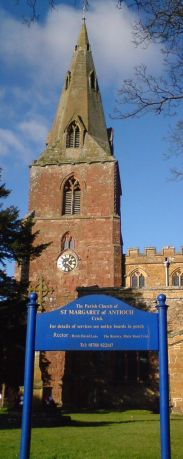
Crick Village
Old School Hall
OLD SCHOOL
The Old School is directly opposite the Church. It has a hall, which is available for booking, and also houses Crick Parish Council office and the Crick Digital Archives. The Archives are useful for those pursuing family research or those just interested in Crick past.
Visit the Booking Details link for booking details.
CRICK DIGITAL ARCHIVE
Many long-term residents commented about “the need to preserve the village’s history”. A small enthusiastic group from Crick History Society responded by using computer techniques to establish a digital archive.
This project began in 2005 and now has a database of over 1200 items including photographs, news articles, maps, researched data and other documents. There are more than 500 photographs. Archived items have been used to assemble exhibitions for May Day - continuous photographs of the event since 1932 - and the VE Day celebrations. Another project involved the researching and publishing details of the Crick Roll of Honour of all the servicemen named on the war memorial. Publication of a booklet containing details of every named person coincided with the restoration of the village’s War Memorial.
Broadly we can categorise the type of information so far captured as
- Early photos of people and places (with dates and names)
- Documents or newspaper articles about the village
- Copies of historical research e.g. Ernest Timmins Collection
- Medieval Manorial data including photographs of Manor Court Rolls obtained by courtesy of St John’s College, Oxford. Much of this data has still to be transcribed
- Village magazines such as Crick News stretching back over 30 years
- Individual records of people, events, clubs or places
- Transcribed and photographed deeds and wills
- House or building histories
- Individual and family histories
- Current photo records of the village and parish, including the building of the M1 Motorway and DIRFT (Daventry International Rail Freight Terminal)
Each source or contributor is uniquely identified and each item provided is catalogued by date, type (e.g. photograph, letter, article, etc) and description (e.g. hockey team or building location). This has driven our archiving methodology
- It is essential that the donor of material is recognised as the primary source of the data.
- All material must be handled sensitively and those sharing information must be kept ‘in the loop’ and shown how their contribution has been used
- It is important, although difficult, to record the date and description of the material in a simple, consistent and pragmatic manner.
- The archiving methodology must be straightforward to ensure
ease of both recording and retrieval. The Crick Digital Archive
requires no special software and runs on low specification computer
hardware.
The ongoing role of the Archive is to continue to scan in additional information and archive it digitally for the benefit of future generations.
For further details or offers of sharing information, contact Jim Goodger, Chairman Crick History Society, at 01788 822723, or email cjgoodger@theiet.org
INTERNET ACCESS
Some of the information in the Crick Digital Archive is available on line at www.westnorthantshistory.co.uk/crick.
HISTORY OF THE OLD SCHOOL
Near the centre of Crick there is a small building known locally as the Old School. The outside remains remarkably like the original infants’ and girls’ school built in 1846. Inside it is quite different and includes a developing village archive.
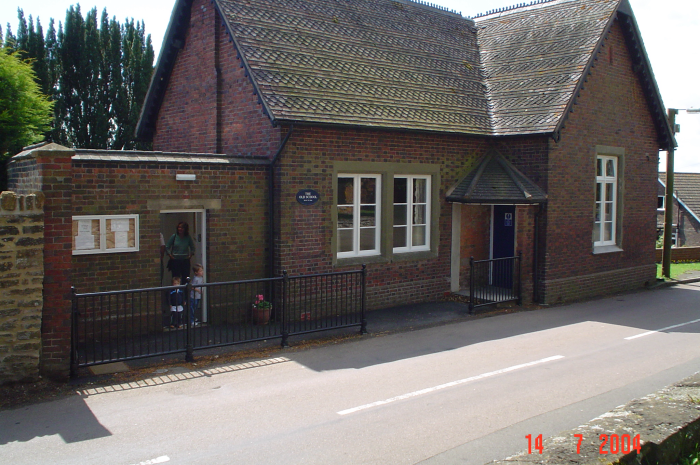
Over 150 years ago children whose parents were unable to pay for their education relied on the distribution from the ‘poor rate’ and the benevolence of local worthies to provide elementary schooling. A Trust for the education of the poor children in Crick was established, building schools for girls and boys in 1846 and 1847. The Trustees for both schools comprised the Rector, two Churchwardens and two Overseers of the Poor (now Parish Councillors). Today the ‘Old School’ is registered as a charity and continues to manage the facilities. The Trustees are now the Rector, 2 Nominees of the PCC and 2 Nominees of the Parish Council.
The 1915 Education Act established universal educational provisions that today we take for granted. Crick Primary School was built on a new site in 1915 and the boys and girls moved to this new accommodation. The girls’ school became known as ‘The Old School’ and was used for all village and church events until the Village Hall was opened in 1959. With the growth of Crick, ‘The Old School’ continues to be used for village, parish council and church events.
The building had become run down and in 2003 the inside of the building was revamped to provide proper disabled access, new toilets, kitchen and redecoration of the meeting hall. A Parish Council Office and computers to store the Crick Digital Archive were developed. Recently the roof has been attended to and the process of refurbishment keeps pace with the continued use of the building.
